
The Kanban Professional with AI Certified (KPC) course is designed for professionals seeking in-depth knowledge of Kanban principles, roles, artifacts, metrics, and processes. This certification equips participants with practical skills to implement, manage, and optimize Kanban systems using both traditional and AI-enabled digital tools.
Courseware and exam preparation resources are provided online through Kanbanstudy. The certification exam is conducted online and is proctored. Classroom, virtual, and e-learning options are available through Kanbanstudy Approved Training Partners. All trainers are accredited, and the certification exam fee is included. Successful participants are awarded the Kanban Professional with AI Certified credential.
Course Objectives
The course aims to:
Build a deep understanding of Kanban origins, principles, roles, artifacts, metrics, and cadences
Enable participants to design, visualize, and optimize workflows for efficiency and continuous delivery
Develop collaborative leadership and value-based prioritization in self-organizing Kanban teams
Integrate AI-driven insights and digital Kanban platforms for better decision-making and reporting
Prepare participants to successfully complete the KPC certification exam
This certification is recommended for professionals who want to apply Kanban at a deeper, more operational level to improve workflow efficiency, collaboration, and delivery outcomes across teams and organizations.
There are no formal prerequisites for this certification. However, completing the Kanban Essentials with AI Certified credential is recommended before pursuing the Kanban Professional with AI Certified certification. Attendance at a KPC classroom training delivered by a Kanbanstudy Approved Training Partner is also strongly encouraged.
High-quality video lessons, study guides, chapter tests, and a case study
Hands-on training using role-plays and real-world scenarios
Certification exam included in the course fee
Complimentary copy of the KBOK Guide
Multiple-choice questions
75 questions per exam
One mark awarded for each correct answer
No negative marking
90-minute duration
Online and proctored
By the end of this course, participants will be able to:
Explain Kanban origins, benefits, application areas, and the role of the KBOK framework
Apply Kanban principles such as empirical process control, iterative development, collaborative leadership, value-based prioritization, self-organization, and visualization
Perform key Kanban roles including Product Owner, Kanban Manager, team member, and stakeholder in AI-enabled environments
Create and manage Kanban artifacts including task groups, workflows, backlogs, and boards using physical and digital tools
Select and configure AI-enabled Kanban tools and define workflow vision and setup
Use Kanban metrics, reports, and cadences to identify bottlenecks and guide continuous improvement
Execute and optimize end-to-end Kanban processes from setup through enhancement
Evaluate and apply AI features to improve forecasting, visualization, and continuous delivery
The course follows a highly engaging, hands-on methodology focused on experiential learning. Participants actively work through concepts and apply them through a structured case study that simulates product development using the Kanban framework.
Key Topics
Kanban origin
Kanban application areas
Benefits of Kanban
Workflow visualization and management
Efficiency and productivity
Flexibility, adaptability, and scalability
Continuous improvement and quality
Why use the KBOK Guide compared to other Kanban references
Purpose of the KBOK Guide
KBOK framework
Kanban principles
Kanban roles and artifacts
Kanban metrics and reports
Kanban cadences and collaboration
Kanban processes
Empirical Process Control
Transparency
Inspection
Adaptation
Iterative or Incremental Development
Meaning and application in Kanban
Benefits for delivery and adaptability
Collaborative Leadership
Definition and role in Kanban
Impact on team alignment and decision-making
Value-Based Prioritization
Concept and relevance
How Kanban enables value-driven delivery
Self-Organization
Concept and importance
How Kanban supports ownership and accountability
Visualization
Importance of visualization
How Kanban implements visualization
Benefits for workflow clarity and decision-making
Kanban Team
Product Owner
Kanban Manager
Kanban team members
Stakeholders
Roles in Digital Kanban Tools or SaaS Platforms
Kanban Artifacts
Tasks and task groups
Kanban workflows
Kanban backlog
Kanban boards
Determine Kanban Vision
Mandatory inputs
Mandatory tools
Mandatory outputs
Determine AI-Enabled Kanban Tools
Mandatory inputs
Mandatory tools
Mandatory outputs
Form Kanban
Mandatory inputs
Mandatory tools
Mandatory outputs
Optimize Workflows and Determine Stakeholders
Mandatory inputs
Mandatory tools
Mandatory outputs
Get Work Done
Mandatory inputs
Mandatory tools
Mandatory outputs
Retrospect and Improve
Mandatory inputs
Mandatory tools
Mandatory outputs
Kanbanstudy is a brand of VMEdu Inc., a global leader in professional training and certification. VMEdu has trained millions of professionals across thousands of organizations in over 150 countries through its global network of training providers.
Kanbanstudy is the global accreditation body for Kanban certifications and the author of the KBOK Guide, a comprehensive framework for implementing Kanban in business workflow management.
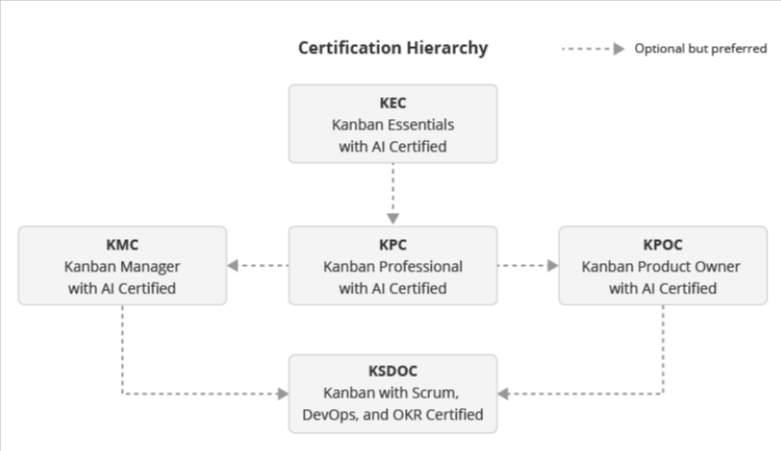
Key Kanbanstudy Certifications
Kanban Essentials with AI Certified
Kanban Professional with AI Certified
Kanban Manager with AI Certified
Kanban Product Owner with AI Certified
Kanban with Scrum, DevOps, and OKR Certified
Kanbanstudy-certified professionals help organizations optimize workflow management, improve delivery speed, and increase return on investment. While most certifications have no mandatory prerequisites, following the recommended certification hierarchy supports logical progression and long-term professional growth.



Reviews
There are no reviews yet.